The Myth That Every Finish Must Match
Metal finishes in a room need not match. Learn how to connect brass, chrome and blackened metal through shape, sheen and placement for a considered look.
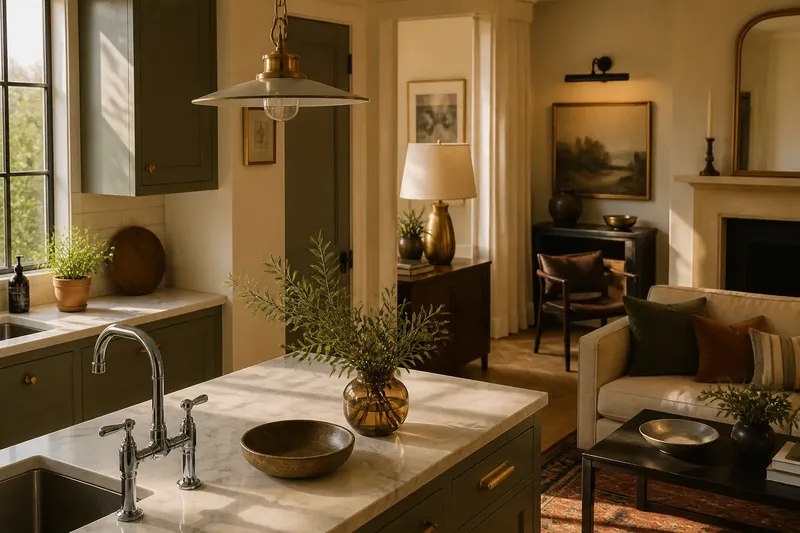
Metal finishes in a room need not match: brass drawer pulls can sit beside a chrome lamp without either looking misplaced. The useful question is whether their differences have a reason, not whether every surface is identical.
A room can hold several metals and still feel considered. A repeated detail—a shared shape, edge or level of shine—gives the eye something familiar while the finishes remain distinct.
Matching finishes is different from connecting them
Matching means choosing the same metal and appearance throughout: polished chrome on taps, handles and lighting, for instance. Connection is looser. Brushed nickel cabinet pulls, a dark iron picture light and a warm brass hinge can belong together if another feature links them.
That feature might be a silhouette. Several pieces with narrow, rounded profiles can look related even when one is brass and another is blackened steel. A shared sheen works similarly: satin surfaces have a soft glow, while polished ones catch sharper highlights.
Finish names are not dependable descriptions of appearance. One maker’s brushed brass may look paler or more textured than another’s. Compare the actual pieces in the room’s light rather than assuming the label settles the matter. Brass and bronze often read as warm; chrome and nickel tend to read as cool, though surface treatments can shift that impression.
Repeat one detail across different metals
Choose one visible feature to repeat across otherwise different pieces. It could be a rounded backplate on cabinet hardware and a circular lamp base, or a black edge on both a mirror and a tap fitting. The repeated detail acts as a small visual refrain, not a demand that every object join the same chorus.
Keep the feature clear enough to notice but modest enough not to dominate. Repeating the exact same shape everywhere can look as uniform as matching finishes. A related curve, a thin rim or a similar level of polish is often enough.
Imagine a kitchen with brushed nickel taps and warm brass handles. The owner considers a pendant with a brass canopy and a slim nickel stem, then compares it with the fittings in the room. Its rounded outline echoes the cabinet pulls, so the owner keeps the pendant; if its polished surface had competed with the brushed finishes, a satin version would have been the calmer choice. The metals stay distinct while the shared curve links them.
Placement gives each finish a role
Where a finish appears matters as much as what it is. Brass scattered in tiny, unrelated spots can seem accidental. Grouping it on a lamp, a nearby handle and a frame gives it a legible presence. A larger area of chrome can provide a quieter counterweight.
Consider what the room already asks the eye to notice. In a bathroom, taps and shower fittings may form a strong cluster. A different finish on a cabinet knob or mirror frame can read as an accent, especially if a small detail repeats it elsewhere. In a sitting room, a dark metal lamp and frame can link across the space without matching a brass side table.
There is no useful rule that says one finish must occupy most of the room. Instead, give each finish a clear job: one may define a functional fitting, another add warmth, and a third outline an edge. If two finishes compete in the same small area, a repeated shape or shared sheen may help. If they sit in separate visual groups, another link may be unnecessary.
Questions about mixing metal finishes
Can brass and chrome be used in the same room?
Yes. Their contrast can feel deliberate when a detail such as shape, edge or sheen repeats between them. Compare the pieces in the room, since brass and chrome vary in tone and reflectiveness.
Do all door handles need the same finish?
Not necessarily. Handles in one continuous sightline may feel more coherent in the same finish, while a separate room or distinct zone can support another choice. Repeating the handle shape can provide continuity across the change.
How many metal finishes can a room contain?
There is no fixed count for every room. The practical limit depends on whether the finishes form recognisable groups or appear as unrelated accents. If a new finish has no clear role or visual link, it may distract more than it contributes.
Should light fixtures match taps and cabinet hardware?
They can, but they do not have to. A fixture can connect through its outline, shade trim or level of shine rather than its metal colour. Compare it with the fittings it will share a view with, not only with a product photograph.
Use samples to judge the combination
Surroundings alter how a finish reads. A warm metal may look muted beside pale timber and vivid against a dark wall; polished chrome reflects nearby colours, while a brushed surface softens them. Place samples or loose fittings beside the room’s paint, tile, wood and fabrics, and view them in daylight and under the lights normally used after dark.
Look at the pieces from the doorway as well as close up. From across the room, the overall balance and repeated shapes are easier to read. At close range, texture and colour differences become more apparent. Both views matter: the combination should make sense as a whole and not become an irritating surprise at the handle.
When replacing hardware, keep an existing piece nearby or take a clear photograph in the room. Showroom lighting can make finishes appear cooler or shinier than they will at home. For product-specific appearance or care, follow the maker’s label and instructions.
Give mixed finishes a clear reason
The point is not to collect metals for variety alone. A finish should earn its place through usefulness, continuity or a particular visual effect. Repeating one modest detail can connect different metals while leaving each piece its own character.
For metal finishes in a room, start with the objects that are fixed or difficult to change, then choose the remaining pieces by shape, sheen and position. If the connection is visible without explanation, the finishes are doing their work. If it takes a paragraph to defend them, a simpler combination may be kinder to everyone.